The importance of restoring balance in our relationships with ourselves, each other, and the planet.
In this podcast, Post Growth Fellow, Wangũi wa Kamonji, explores the journey from coloniality to regeneration, drawing on Afrikan Indigenous knowledge, Earth wisdom, and ancestral guidance. Through reflections on healing, sovereignty, and community, she unpacks the harmful legacies of colonialism and the importance of restoring balance in our relationships with ourselves, each other, and the planet. Wangũi invites us to imagine and embody the pluriverse — “a world where many worlds fit.” Listen to the audio or read the full transcript as we explore these transformative pathways.
My name is Wangũi and as I begin this piece I honour and acknowledge the lands and waters I belong to in Ongata Rongai, East Afrika, my ancestors and the many beings with whom we have been in relationship over generations, our Earth relations and spirit guides and teachers. I honour you dear reader, your lands and your people who are with you now.
I want to speak about and beyond coloniality. I also want to consider what is required in the transitions from perpetual coloniality into the restoration of a pluriverse or ‘a world in which many worlds fit’ as the Zapatistas speak of. The definitions and framework I share here have been articulated in conversation with pan-Afrikan indigenous knowledges and practices, in conversation with Afrikan histories, in particular the histories of settler colonies in Afrika, and in conversation with whole community, that is Spirit, Earth and my whole being, body, heart, spirit and mind.
To transition to, embody and thrive in the pluriverse, that is in a world in which many worlds fit, we need to engage processes of healing from coloniality to regeneration.
What is colonialism and why is it so harmful?
A simple definition of colonialism I like to use is that colonialism is the process of one world eating other (possible) worlds, to use a metaphor of eating that is prevalent and meaningful in many Afrikan cultures. Colonialism’s ingredients include a belief in separation and superiority, an assumption that life and development are teleological with a destination determined by whiteness, a desire for accumulation, the abstraction of knowledges and agency from all beings who hold both including Earth and humans, and the privileging of the rational or intellectual above all other perspectives for engagement with the world.
Coloniality refers to the persistence of shapes and structures created by colonialism beyond the formal end of administrative colonialism. Coloniality exists when patterns of power that emerged as a result of colonialism endure after colonialism and continue to define institutions, culture, labour, interpersonal relations and knowledge production beyond the end of colonial administrations i.e. “flag independence”. Coloniality is a shape that we are born into and entrained to continue perpetuating through all the systems, educational, administrative, cultural and structural that we navigate in societies that experienced colonialism.
In this sense coloniality is static, or as I prefer a State-ic regime. Coloniality freezes. It constrains fluidity and flow in thought, shape, speech, pattern, feeling, action and ultimately constrains possibilities beyond itself. This constrainment is experienced on all layers of being — intrapersonal, interpersonal, group and cultural layers.
Regeneration, encompassing decolonisation and reindigenisation processes, is an antidote to coloniality.
What is regeneration and how is it an antidote to colonialism?
I use the term regeneration to speak about various indigenous Afrikan life philosophies that tend to the presence, continuation and renewal of life. In this way, I bring regeneration, an often-neutralised ecological term, into conversation with the oppression of and liberation from coloniality.
Regeneration may be known by many different names in different Afrikan communities according to the life values and philosophies that these communities pursue. For example, the life value of ubuntu from Nguni speaking communities of southern Afrika, and the related hunhu from Shona peoples or utu from Swahili speaking peoples is well known. Among the Agĩkũyũ of East Afrika, the communal life value upheld and pursued was thaayũ, meaning peace. Thaayũ is internal and external peace which is present when wellbeing and justice persists. It takes into account one’s whole self and the wholeness of community, i.e. peace with humans, the Earth, with ancestral spirits, and with the creator, Ngai. On another hand a life philosophy of the Tswana in southern Afrika is ibuhle meaning beauty. Beauty and the imperative to generate beauty, where beauty means balance and relatedness.
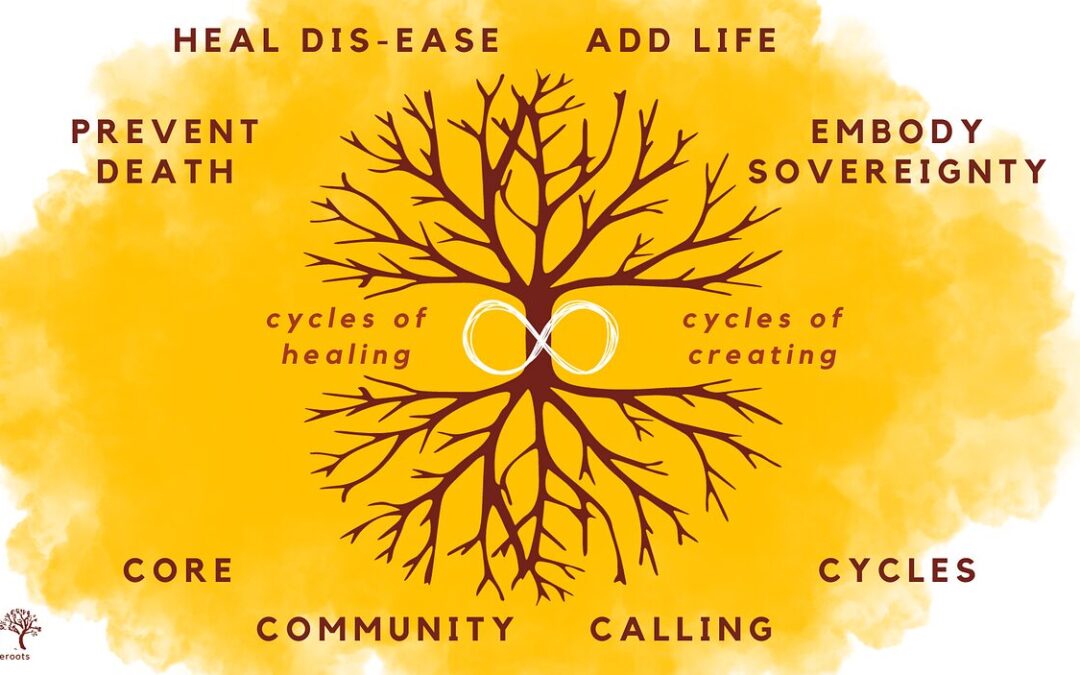
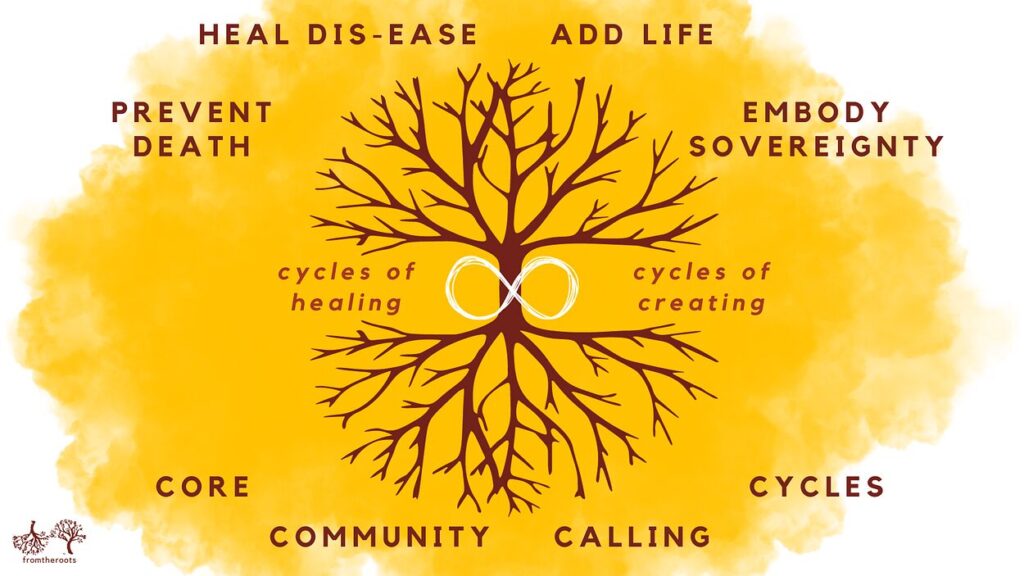
These examples serve to indicate how particular named life philosophies contain within them four necessary ingredients of regeneration, namely, having the individual and communal agency to engage in actions that prevent death, heal dis-ease, and add life to all. For the times we live in, I define regeneration as a process of restoring and bringing more vigorous life to the capacity of humans, more-than-human Earth beings, and unembodied spirit kin to continuously choose, direct and engage in actions and processes that 1. prevent death, 2. heal dis-ease and 3. add life to community after the damage of colonialism. Engaging and flourishing regeneration implies enacting our embodied sovereignty as communities and individuals which is the fourth regeneration branch.
Preventing death implies maintaining the communion amongst humans, ecologies and spirits and ensuring basic needs are met so that life is maintained. Healing dis-ease implies intervening for repair in moments of deflection from the goals of continuity and thriving life wherever these may occur. Adding life implies increasing the quantity and quality of interrelationships amongst humans, ecologies, and spirits. All indigenous communities had practices for each of these processes and practices that accomplished more than one of these goals as well.
How do we approach regeneration, or arrive at restoring our capacity to embody our sovereignty, to prevent death, heal dis-ease and add life?
Moving from coloniality to regeneration is exactly that, a movement, a transition, and one that invites us to engage cycles of healing and cycles of creation in order to unfreeze the State-ic regimes of coloniality and to create new possibilities before not possible collectively. Colonialism, the process of one world eating other worlds, generated trauma for both colonisers and colonised. This historical trauma keeps running until attended to. Creating new worlds and recreating worlds anew requires us to reckon with the distortion and eating of worlds that happened through colonialism.
Collective understanding and recognition of historical, intergenerational and ongoing trauma has increased in recent years and there are many more tools and practices available to us as individuals to engage in healing. We now recognise that trauma lives in the body, that trauma is intergenerational and that it is also pervasive. In addition to new embodied tools, in indigenous (and) Afrikan communities we are re-membering collective ancestral tools that had always been present with us for dealing with trauma such as collective song, story and Earth based rituals.
Let’s pause for a moment and reflect
Recall a time you have been hurt physically and had to heal. Was healing immediate? Was it quick? Was it painless? Was it easy? Did it happen at the snap of a finger? In healing processes I have been through none of these were the case. Healing isn’t quick or within our timelines and desires for comfort and easy. Healing doesn’t imply a cure that erases, but integrating the reality of woundedness within our wholeness in a way that it doesn’t continue to wound or fester. Furthermore even when physical wounds have scarred over, our bodies continue to produce scar tissue to keep the wounds closed. Healing, it turns out, is a continuous practice.
What happens if we don’t engage with the healing process?
Perhaps more so than physical healing processes, when it comes to social-emotional-mental healing, humans tend to resist healing processes on individual, interpersonal and collective levels. In particular we resist the metabolising stage of healing processes. Akin to the pupal stage of a butterfly when the caterpillar is in cocoon turns to goo and transforms, healing requires a kind of collapsing and reckoning with painful realities. This is perhaps the most difficult stage to move through. We are afraid that the falling open implied in this healing stage will be the same as the falling apart of the wound-causing trauma. Yet trauma is only one possibility. The butterfly is another. Both imply melting into goo first.
Unfortunately in resisting the healing processes we need to engage, we tend to recreate and prolong the trauma. We may also in avoiding the unknown of healing cling to the known of coloniality which is only too willing to provide distractions and compensations that do not deeply satisfy nor create thriving life. This re-inscribes and accentuates pain on human and more than human bodies and also continues to derail and delay radical and necessary transformation.
Yet transitions are desperately needed, so what do we do?
Here is the final piece of my invocation: the ‘fromtheroots’ model proposes that being deeply grounded in the roots of core, calling, community and cycles while we engage healing and creating processes will support us to divest from coloniality and practise regeneration.
Said differently, for us to divest from coloniality and live and practise regeneration, we must engage processes of healing and processes of creating. To have the willingness and stamina to engage in healing and creating sustainably and with grace, we need to be deeply rooted in core, calling, community and Earth cycles.
These four roots create the necessary containers for us to feel safe enough to fall open without fearing that we are falling apart and disintegrating. That is, they make it safe enough that we resist less, and for shorter periods of time each time we are confronted with our own commitments to the State-ic regimes of coloniality. And because transitions imply loss and all loss is accompanied by grief, these roots hold us and witness us through our grief enabling us to relinquish our commitments to coloniality with greater ease and find nourishment elsewhere.
I will unfold each of these roots briefly beginning with the widest one. I invite you to notice, how are each of these roots for me? Do they exist, are they healthy, how deep and wide are they?
The root of CYCLES implies re-embedding into and attuning to cosmic and Earth rhythms of changing seasons and the cycles that all beings, projects, creations, etc go through. Cycles are the larger context within which our stories are playing out and locate us in timespace. Cycles are many ranging from the diurnal cycle of Sun and moon, the local rhythms of what the Earth, animals and plants are doing where you are right now, to the planetary cycle of equinoxes and solstices and beyond to other planets’ cycles which may be instructive. Rooting in cycles invites to re-embed in these larger cycles and also come into relationship with our own cycles of healing and creation.
The root of CALLING is the root of becoming. Tending this root means exploring and coming to know the gifts we came to the world to experience, learn and deliver. A feature of indigenous Afrikan lifeways is valuing each human life and viewing each person as being in the world for a life-giving purpose. When we respond to calling with purpose we engage our responsibility to meaningfully participate in the world. Having purpose as a central tenet of indigenous life presupposes the care that one offers to a life in order that that purpose may be realised, hence,
The root of COMMUNITY, which is the root of care and belonging. This root invites us into healthy relational practice with other humans in one to one and group relationships; with Earth and our Earth relations; all the embodied beings with whom we share Earth; with ancestors, spirit guides and one’s sense of the Divine; with our histories and our locatedness in place. Tending this root is both nourishing and generative and contributes to forming and shaping
The root of CORE implies being, Self-knowledge, awareness and self relating.
Tending this root we come into relationship with the wholeness of who we are as spirit, body, heart and mind. We come into awareness of our dignity, belonging and safety as unshakeable and unquestionable hence enabling us to step out of unsatisfactory colonial ways of being.
Re-rooting ourselves in each of these four roots begins our processes of re-membering our colonially dismembered self and community wholeness so that we can courageously face reality, heal, and create to move towards visions of the pluriverse.
The process of re-membering is somatic, it is relational, it is communal, it is supported both by seen and unseen community (human and more than human), and our deep commitments and intentions towards decolonisation, re-Indigenisation and regeneration. In re-membering self and communal wholeness we make possible again fluidity where there is stuckness of colonial patterns, embodiments, thoughts, stories, narratives. We make life possible again — all of which contributes to shaping visible manifestations in the form of policies, programmes, and projects.
As I finish, I invite you to notice your body again and notice where all this has landed for you. Feel free to place a hand there and to breathe into that place to invite accompaniment and space around it.
In power and gratitude as we revivify the pluriverse.
Originally posted on Medium by Post Growth Institute